


Why Your Breaker Keeps Tripping (and When to Stop Resetting It)
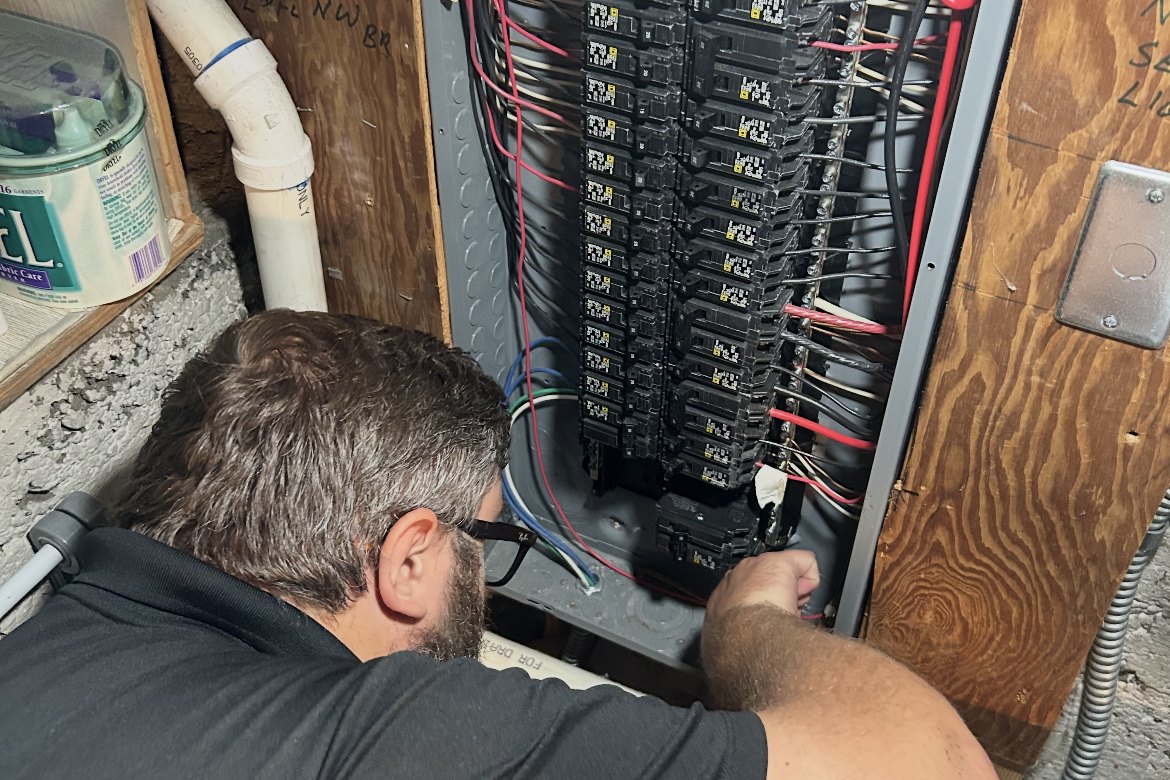
A breaker that trips once is doing its job. A breaker that trips again after you reset it is trying to tell you something, and the message depends a lot on when it happens and what else is going on in the house.
This is the long version of the answer we give on the phone every week. Find the section that matches what your breaker is doing, and you will have a good idea whether this is a Saturday morning fix or a call to us.
First, what a breaker is actually protecting
Every circuit in your panel is rated for a certain amount of current, usually 15 or 20 amps for lights and outlets, more for big appliances. The breaker is a switch that shuts the circuit off when the current goes past that rating for too long, or spikes suddenly. Without it, the wire in your walls would carry that current until it got hot enough to start a fire.
So a tripping breaker is not the problem. It is the alarm. There are four things that set it off:
- Overload. Too much running on one circuit at the same time. The most common cause by far.
- Short circuit. A hot wire touching a neutral or another hot, usually from damaged wiring, a bad appliance cord, or a failed device. The breaker trips instantly and hard.
- Ground fault. Current leaking somewhere it should not go, often because of moisture. GFCI breakers and outlets are built to catch this.
- A worn-out breaker. Breakers are mechanical. After enough years and enough trips, some start tripping below their rating or fail to reset cleanly.
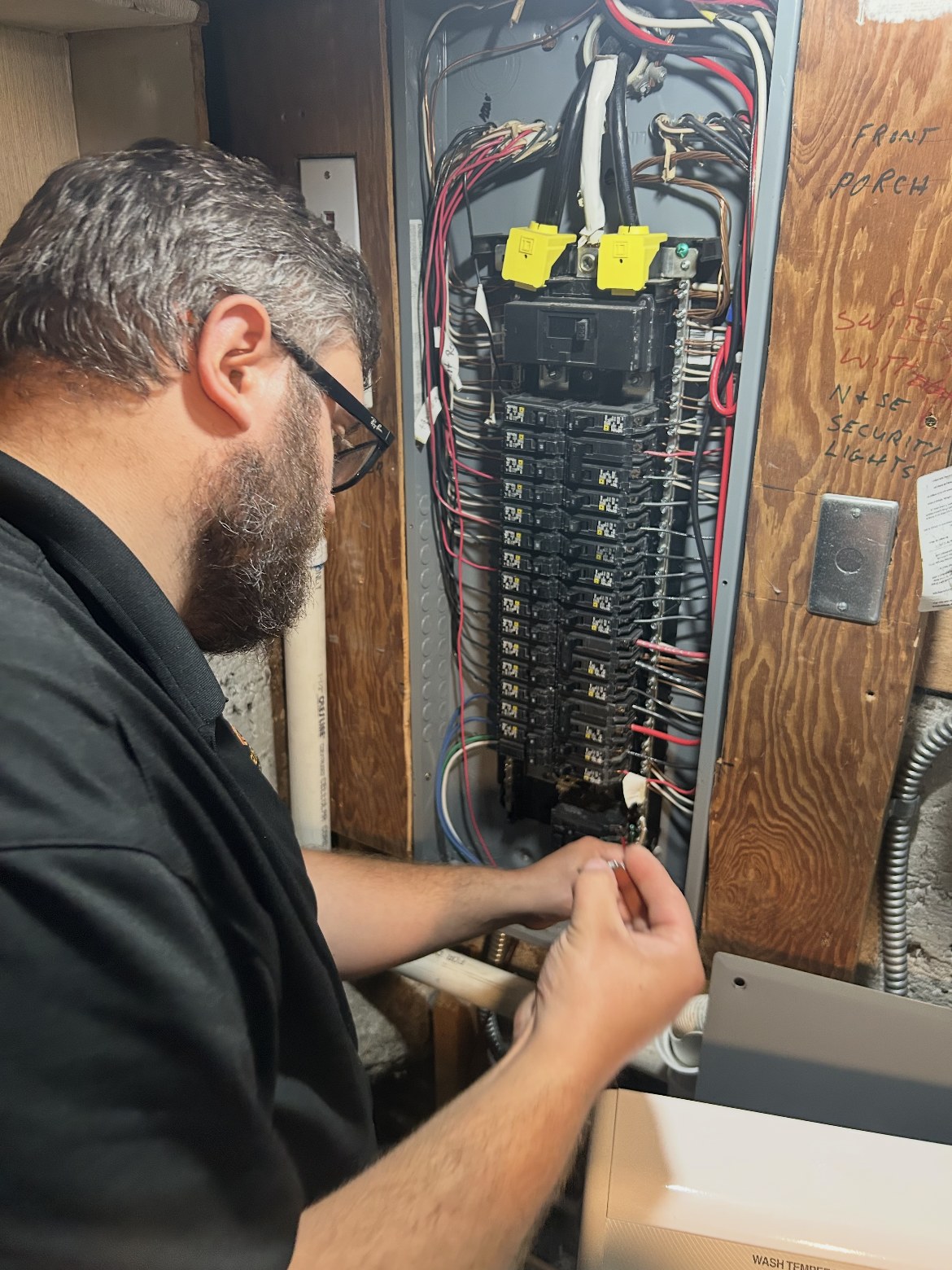
It keeps tripping in one room
Almost always an overload. Bathrooms, kitchens, and home offices are the usual suspects because that is where the high-draw stuff lives: hair dryers, microwaves, toaster ovens, space heaters, and a laser printer or two.
Around here the pattern is seasonal. In October the space heaters come out, they get plugged into the same circuit as everything else in the bedroom, and the breaker starts tripping every evening. One 1,500 watt heater uses most of what a 15 amp circuit can give.
Try this: move the biggest appliance to an outlet in a different room and see if the tripping stops. If it does, you have found it. If that circuit trips even with very little plugged in, keep reading.
It trips randomly, with nothing plugged in
This one worries people, and it should get looked at. A few possibilities, roughly in order of how often we find them:
Something hardwired is on that circuit that you are not thinking of. Furnaces, well pumps, garbage disposals, bathroom fans, and garage door openers do not plug into a visible outlet, and any of them can fault.
Moisture. Our winters are wet, and outdoor outlets, garage circuits, and anything near a crawlspace can get enough damp inside a box to leak current to ground. If the random trips line up with rainy days, that is a strong clue.
A loose connection somewhere in the circuit, at the breaker, at an outlet, or in a junction box. Loose connections heat up and arc, which can trip a breaker unpredictably and is a real fire concern.
Or the breaker itself is tired. Breakers that are 20 or 30 years old sometimes trip at well under their rating. Replacing a worn breaker is a quick fix for us, but we want to confirm it is the breaker and not something upstream before we swap it.
It trips immediately every time you reset it
Stop resetting it. A breaker that trips the instant it closes is almost always seeing a short circuit or a hard ground fault, and every reset sends another jolt through whatever is damaged.
If you want to do one safe thing before calling: unplug everything on that circuit, then reset once. If it holds, plug things back in one at a time until it trips, and you have found the bad appliance or cord. If it trips with everything unplugged, the problem is in the wiring or a hardwired device, and that is our job.
The main breaker keeps tripping
The main is the big one at the top of the panel, and it protects the whole house. When it trips, either the entire house is pulling more than the panel is rated for, or there is a problem in the panel itself.
The first case is getting more common. A lot of homes in Snohomish County were built with 100 amp panels for a house that had a gas furnace, a gas water heater, and a couple of window units. Add a heat pump, an EV charger, an induction range, and a hot tub, and that same panel is now working at its limit on a cold evening. We wrote about the EV side of this in our post on whether your panel is ready for a charger, and a panel upgrade is usually a planned day of work, not a week without power.
The second case, a fault inside the panel, is not something to wait on. If you see scorching, smell anything hot, or hear buzzing or crackling from the panel, leave it alone and call us.
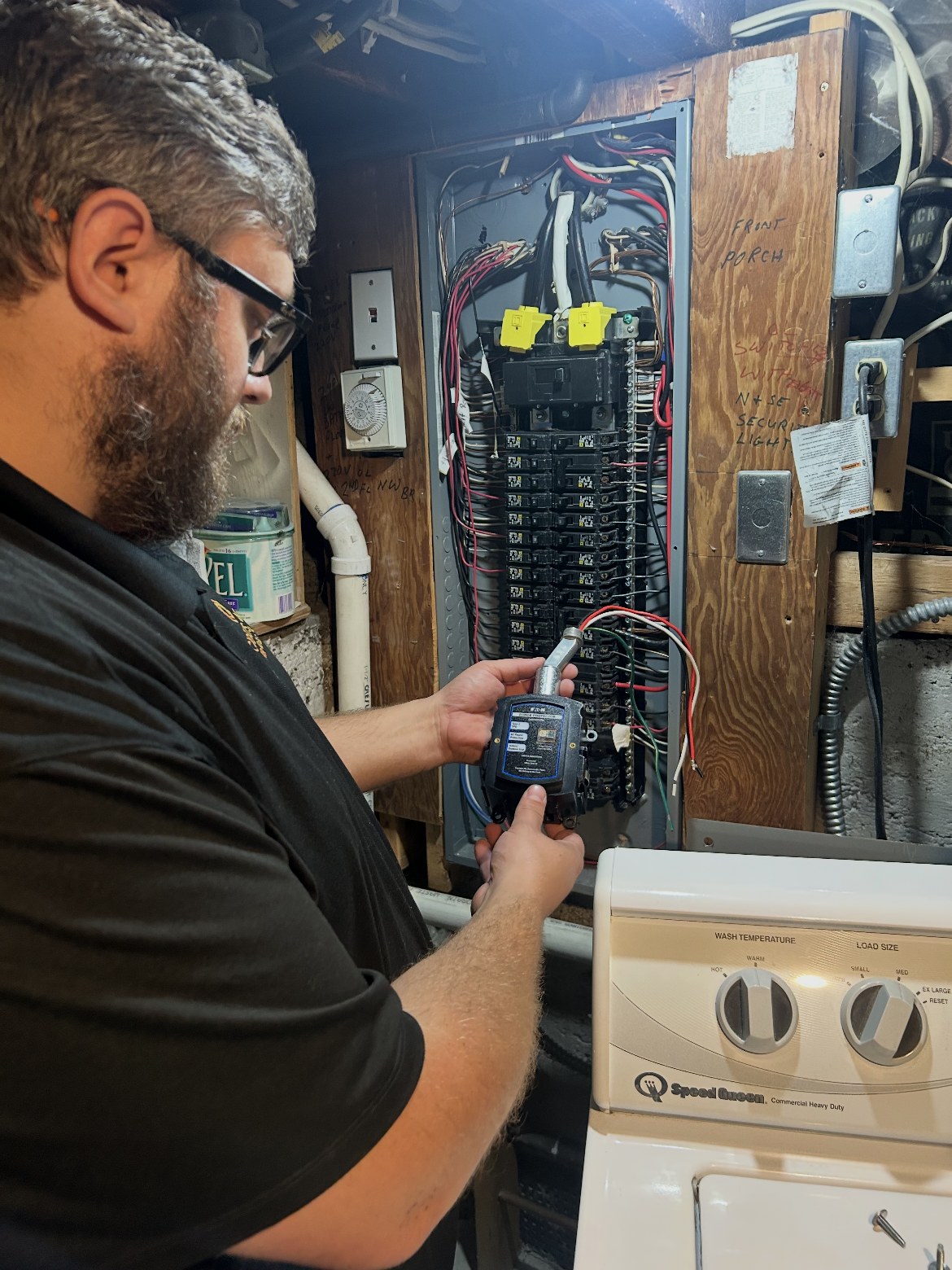
The AC or heat pump breaker keeps tripping
This is the one where it helps that we do both trades under one roof. A heat pump tripping its breaker is usually a mechanical problem wearing an electrical disguise.
The common causes are a clogged filter or dirty outdoor coil making the system work too hard, a failing capacitor, a compressor that is starting to draw too much current, or a refrigerant issue. Occasionally it really is the breaker or the disconnect. Either way, do not keep resetting it. A compressor that trips its breaker repeatedly is a compressor on its way out, and that is the most expensive part in the system. Call us for heat pump repair instead.
If the house has gone cold while you sort it out, your thermostat has a backup setting for exactly this situation. We explain it in what EM heat means on your thermostat.
If you are on one of our maintenance plans, this is exactly the kind of thing we catch at the fall visit before it becomes a January emergency.
A GFCI or arc fault breaker keeps tripping
These are the sensitive ones, and they are supposed to be. GFCI breakers watch for current leaking to ground, which mostly means moisture: bathrooms, kitchens, garages, outdoor outlets, and anything near a hose bib. Arc fault (AFCI) breakers watch for the electrical signature of arcing, which can mean a damaged cord, a loose connection, or in some cases just an older vacuum or treadmill motor that the breaker does not like.
Both types can nuisance trip. Both types also catch problems a regular breaker would miss. The fix is never to replace them with a standard breaker to make the tripping stop. If a GFCI trips repeatedly and you cannot find water, or an AFCI trips on a circuit with nothing unusual on it, have it looked at.
What you can safely do yourself
- Reset a tripped breaker once. Push it fully to OFF first, then back to ON.
- Unplug appliances one at a time to isolate an overload.
- Move a space heater or other big load to a different circuit.
- Press RESET on a GFCI outlet.
- Check whether the trips line up with rain, a specific appliance, or a specific time of day. That pattern is the most useful thing you can tell us when you call.
When to call
- The breaker trips immediately on reset.
- It trips with nothing plugged in.
- The main breaker trips.
- You see scorch marks, smell burning or hot plastic, or hear buzzing from the panel or an outlet.
- The breaker feels warm, will not stay reset, or feels loose.
- Your panel is a brand that has a known history of failing to trip. If you are not sure, send us a photo and we will tell you.
Our electricians are in-house, licensed for residential and commercial work, and based right here in Lake Stevens and Everett. Call (425) 496-7300, tell us what the breaker is doing and when, and we will tell you honestly whether it needs a visit. Sometimes the answer is "move the space heater." We are fine with that.
If your breaker started tripping right after a power outage, we have a separate post on why that happens and what to check first.
Customer Testimonials
Service Areas
